Thursday, January 6, 2011

Finding Inspiration in Unlikely Places

One never knows where or when inspiration will strike and when it does it's sometimes difficult to sustain or duplicate.  But if you keep your eyes, ears, mind, and heart open as you slog through every day life, you may just find inspiration in the most unusual of places.

I am a musician and teacher, not necessarily a 'sports guy' (though the woman in my life might argue that point). For years I was an avid talk-radio listener but I found myself so anxious and uneasy during one contentious election cycle that I simply turned the dial.  By chance I stopped at sports radio 1310 The Ticket in Dallas, TX

The shtick and stats were just the kind of mindless drivel my topsy-turvy stomach needed and I welcomed the break.  But what got me 'hooked' on the Ticket was the fervor that almost all of the hosts displayed about a wide array of topics, not just sports.  In particular, the passionate musings of one Norman "Norm"  Hitzges continue to be both entertaining and inspiring upon every listen.

Norm is known for his unbridled enthusiasm, knowledge of sports, sports trivia, and all the minutia that drives most non-sports fans (or girl-friends) completely crazy. But listen for more than a few minutes and you'll learn that Norm has many interests and can speak knowledgeably about a wide array of topics. 

Norm loves to travel and often shares stories about the exotic locales, interesting vistas, harrowing outings, and wonderful food he has experienced as a veteran globe-trotter.  His bio page at the Ticket website includes an amazing slide show with pictures of some of the incredible places he has visited. It's worth a look.  The tales he tells of his travels are expressed so eloquently that he might easily earn a spot on any National Geographic special.

His interviews, though mostly sports related, are often sprinkled with cultural topics and he is equally adept at discussing baseball as he is breeds of dogs, fine wine, art, the Guinness Book of World Records, and even music. He is an amazing linguist and has a terrific vocabulary. His colleagues have deemed him the 'poet laureate of Valley Ranch' for the weekly verse he writes about the woes of yet another failed Dallas Cowboy season.  One of my favorite 'Norm-bits' is his recap of interesting and unusual names of players coming through the annual NFL Draft - it's pure genius.

What I find most inspiring about Norm is that he has seemingly reached a level of symbioses between his personal life and his professional career.  He has been a long-time supporter of the Texans Can! Academy, an organization that provides at-risk youths with education and training. And each year he hosts the 'Norm-A-Thon' that raises funds to support the Austin Street Centre for the homeless.  It's an incredible 18 hour marathon broadcast filled with a wide variety of topics, interviews, and of course, 'shtick'.  In my humble opinion, for entertainment purposes alone, it frankly puts the Jerry Lewis telethon to shame. 

I've never met Mr. Hitzges, but if I ever get the chance, I will be sure to tell him that his daily example is like inspirational fuel for me.  I can only hope to achieve the same level of expertise, comfort, and humility in my life and chosen profession.

Thanks for showing us that it can be done Norm, and keep up the great work!

Norm Hitzges is also an author and member of the Radio Hall of Fame. He writes a sports blog and can be heard weekdays on the Ticket from 10 AM to Noon.

Monday, January 3, 2011

A Look Back - A Look Ahead

There were huge changes at MusickEd in 2010, both behind the scenes and on the site.

Most apparent to our users is an entirely new design of the website from the main page to the interface within the software. There are so many levels and so much information available within each lesson that it became a challenge to create an intuitive, music learning experience for the end user...but we think we've  accomplished our goal!

We also moved from a download and install format to a subscription service.  This required a massive amount of tedious coding and detail work by our staff  - there are 3,960 secured links for each of the 39 instruments in the Kore Series!. Kudos to all of you for your patience, perseverance, and a job well done.

Finale Reader was added to our site this year as well.  It's a wonderful product that allows us to maintain the look and feel of the songs regardless of the browser choice of our users. And,oh by the way, Finale Reader is a FREE product!

We also added song titles to all finale pages through lesson 12.  The titles not only look great when printed, but they make it lots easier to keep things in order through the learning process.

In 2010 we moved from StoreFront (which typically services shopping cart transactions) to Pay Pal which could more easily manage our subscription service. PayPal was an obvious choice as it reliably handles over 150 million online accounts from all over the world.

In November we created and published an audio primer that helps users (and future users) better understand our product and how to best use the software to expedite the learning process.  We have had lots of positive feedback about this addition

We made a major push to make social media components a larger part of the  MusickEd  community and experience.  Our blogfacebook, twitter, and youtube pages can now be viewed by members and non-members alike.  And we made our entire community (including the forums and webinars) more easily accessible from any of the pages within our software.

We introduced school, private organization, and church pricing plans as we began to see an increased interest from these organizations during the course of 2010.  We will be making a concerted effort to attract these groups by attending a few conferences next year, beginning with TMEA (Texas Music Educators Association) in San Antonio this February.

Video production of the lesson songs ramped up in 2010. Some of the videos completed include Kore Series songs for cello, soprano sax, soprano voice, baritone horn, and all 20 lessons of alto saxophone. We will begin a robust schedule of recording this January with a goal of completing all 20 lessons for all instruments by the end of 2011.

We've also begun to incorporate user videos within the software and we look forward to receiving many more entries this year.  Users can send their video performances of our songs (with the background only track) and we will add them onto the appropriate lesson and instrument page.  Several videos have already been published thanks to some of the students on campus at DSM.

The Jazz Series has also begun to take shape in 2010. Mr. Finkel has completed writing the original songs for all 20 lessons.  He has also recorded each song and the background tracks through lesson 14.  Noted Jazz Educator Dan Haerle has finished writing the text for 19 of the 20 lessons and has decided that lesson 20 will be dedicated to common chord progressions that occur in Jazz Standards. This will be an amazing series that bridges the gap between play along only material and practical jazz education. We're hoping to make some of the Jazz Series lessons available by June with the entire series expected to be completed by December.

Phew... there's no more time to waste, I've got to get to work. Happy New Year!

Monday, December 6, 2010

Top 10 of 2010

It was a terrific year of writing, interviewing, and making some great connections through our blog. Our #1 rated blog What's Wrong with Music Education? was a run-away winner because of the variety of feedback we received not only nationally but internationally as well.  Below are the top 10 DLP blogs of 2010 by number of visits, re-visits, re-posts and feedback from our readers. 

10The Mozart Effect: Finally Some Clarity  If you want music to sharpen your senses, boost your ability to focus and perhaps even improve your memory, you need to be a participant, not just a listener.

9. Improvise Like a 7 Year Old  You are 7 years old. School is canceled, and you have the entire day to yourself. What would you do? Where would you go? Who would you see?

8. Meet Lisa Canning of Entrepreneur the Arts "Too often in the arts it is about what WE, as artists, want to accomplish and not about what WE CAN DELIVER to our audiences. Entrepreneurship makes this flip possible."

7.  MusickEd Plays a Role in MS Patients' Recovery  "I feel like the connections in my brain are being re-wired", Toni says "Steve and my friends in the support group have noticed too." 

6. How Not to Capture Learning Myth: if music education in school introduced kids to classical music early enough, we'd create younger audiences for the future. Fact: No it won't. 

5. Music to Our Ears - Bravo Phllip Ball!  But it will be a sad day when the only way to persuade educationalists to embrace music is via its side effects on cognition and intelligence.  

4. Charting Creativity Grab a timer and set it for one minute. Now list as many creative uses for a brick as you can imagine. Go. 

3. Create the Check Box What's our check box?  We are entrepreneurs in music education. Yes, you heard me right. I'll give you a moment to re-read that one more time. We're used to it.

2. The Other 80% Technology indeed has never been more important to music education, but if we strive only to reach that 20% - we will have sold ourselves very, very, short....again. 

1. What's Wrong with Music Education? It’s time to realize that music education is an amazing commodity. There is no shelf life, the rules will never change, and just about everyone would love to learn about music if the opportunity presented itself appealingly.

Monday, November 29, 2010

What's Wrong with Music Education?

It’s said the definition of absurdity is repeating the same thing over and over and expecting different results. So it seems is the case with music education. Why are music educators constantly battling for the survival of their programs when it’s basically common knowledge that learning music can have all sorts of benefits?  I understand the benefits may be debated (does it really make you smarter?...doubtful) but most folks will agree that learning music is a “good thing”. 

So how did we get here?

The boom in school music programs during the 1960's and 70's now seems like a distant  memory. In retrospect, it may have had the same effect on our profession that the internet boom had on start-ups. What appeared to be a good model was in fact one of unsustainable growth. And rather than taking advantage of the large numbers of interested participants (as well as unprecedented support from administrations) our programs often became over-protected and less inclusive.  By the time funds and support had begun to dwindle, we could do no better than try to convince those in charge about the power of the Mozart Effect or 'music aids spatial reasoning' experiments.


And now....?


Watching a symphony play 200 or 300 year old music (or even 50 year old music for that matter) is just not something the current i-pod, Wii or Guitar Hero generation wants to do. And learning to play that music is even less appealing a proposition.  And while our profession looks longingly to its past, often clinging stubbornly to18th century ideals and methods of teaching, it is also very slow to adapt anything ‘new’ - and that is an unhealthy combination.

All of this seems a little baffling as there has never been a time in history when a larger amount of music has been accessed by more people, and you would think the profession would do all it can to capitalize on this trend by making music more accessible to a wider demographic. Instead, we’ve hunkered down in academia, teaching pieces to band, choir, and orchestra members who very rarely continue to play after high school.  


Some Solutions 


It’s time to realize that music education is an amazing commodity. There is no shelf life, the rules will never change, and just about everyone would love to learn about music if the opportunity presented itself appealingly.

Here are 5 ideas for starters:

1. Let’s make entrepreneurial and business classes mandatory for all future music educators. Encourage the development of professionally designed curriculum that consists of real music learning material - not short-cuts or gimmicks. Make the interface user-friendly and present concepts sequentially using a variety of the latest available technologies.

2. Make professional music education easily accessible via the internet.  Make it personal, and affordable.   Make the process of learning so clear that it can be used by individuals of all ages and levels of ability. Keep the material concise and flexible enough so that it can be adopted by school music programs, home-schoolers, and other organizations interested in accessing quality education for their members.

3. Allow this new product to be edited quickly so that all users always have the most current version. Encourage users to participate in a music learning community by submitting ideas, additions, and even video and audio samples of their own performances.

4. Make true music education available for all instruments, including voice, guitar, bass, electric guitar, piano, and keyboard (not solely band and orchestral instruments).

5. Use new and varied genres of music for playing and listening examples rather than outdated songs, examples, and exercises.

The onus falls on us as educators and the profession as a whole to change the focus of our efforts away from fund-raising and philanthropy and on to creative, healthy change. Until we begin to reach current and future generations in the manner that they are accustomed, the profession will remain in its current state and will have fallen short of expectations.

Thursday, November 18, 2010

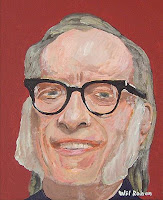
Isaac Asimov Saw the Future of (Music) Education

Portrait by Wil Rohan

Could it be that Isaac Asimov was a prophet as well as being a biochemist, science fiction writer, and oh by the way, longtime Vice President of Mensa International?  The video below is part of an interview conducted by Bill Moyers back in 1988. 

The men talked about many subjects including overpopulation, economics, and science.  But in one particularly interesting segment Asimov began musing about the coming technological explosion of connectivity and learning. He surmised that computers would "transform education" and indeed personalize it away from the “industrial model” where everyone learns the same thing at the same time from the same model, to a more personalized experience. 

There will be a time in the future when computers will be hooked up to "enormous libraries where anyone can ask any question and be given answers, be given reference material."  He continues, "From an early age, however silly it may seem to someone else, that's what you're interested in . And you ask, and you can find out and you can follow it up. And you can do it in your own home, at your own speed, in your own direction, on your own time.  And everyone will enjoy learning." 

This idea is one of the main reasons why we created MusickEd.com and discoverlearnandplay.com.  We knew that the internet was an ideal way to access and relay information and musical concepts were no exception.  We simply needed to package and deliver our brand of music education smartly so that people of all ages, in all locations, and at all levels of ability could gain access and start learning!

"Our brand" of music education is simply that which we have been providing here at DSM for the past 20 years. Through thousands of one on one sessions with our students, we've learned to organize and present quality music education information in plain language using no gimmicks.

Here's hoping Isaac would approve and that he is looking down and smiling!

Watch the segment below or access the entire interview at Bill Moyers Journal


Music